


CREATION OF A PARABOLIC MIRROR 410 mm f/4.5 – PARABOLIZATION
After bringing the mirror to the sphere, the moment of parabolization has arrived, which in many respects is perhaps the most delicate phase of the entire process.

After bringing the mirror to the sphere, the moment of parabolization has arrived, which in many respects is perhaps the most delicate phase of the entire process.

The mirror processing was carried out with a mirror-o-matic type machine, characterized by a rotating table and an oscillating arm on which the tool is fixed.

In these chapters I will describe the phases that led me to the creation of a parabolic mirror 410 mm f/4.5, focusing first on the phases that led me to create a good spherical surface

The manufacturing phases of a meniscus parabolic mirror 610 mm in diameter and 20 mm thick, focus 1770 mm with focal ratio of F3.
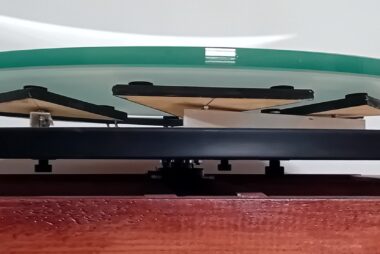
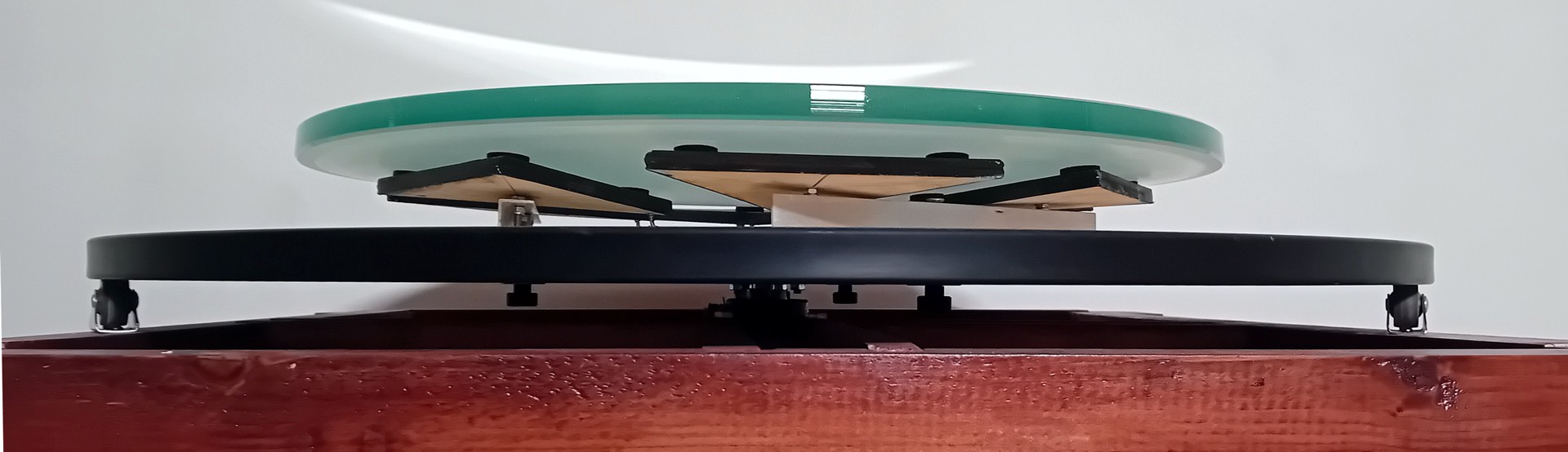
A simple rotary table for working mirrors, homemade with some carpentry tools…

The escalation towards the amateur construction of ever more powerful Newtonian Dobsonian reflector telescopes (thanks to parabolic mirror lenses of ever larger diameter trying to contain their weight) it collides head-on with some technical problems that grow exponentially with respect to the benefits provided.
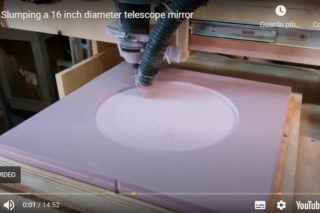
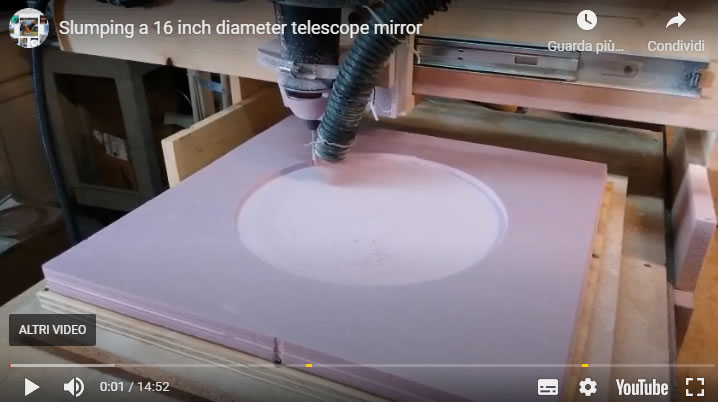
I refer to the following Michael Davis Youtube video that I have seen with interest and attention, also thanks to the “lock-down” impediments, fortunately so far in good health, successive in these times of crown virus, also considering that the English language dialogues of the films, constitute in Italy an obstacle for all willing and maybe scratch glass

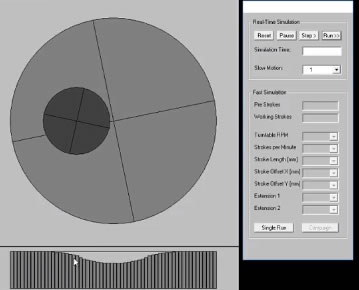
Small tutorial on using "minimum" of POLSIM software for the processing of a parabolic mirror telescope, "Assisted" by the use of a simple rotating plate, even in the digging operation of the "arrow" of the initial spherical concavity. The program was written in 2007 da Martin Cibulski, and it can be downloaded as polsim.exe (download) , as other interesting Articles
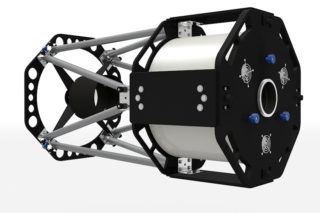
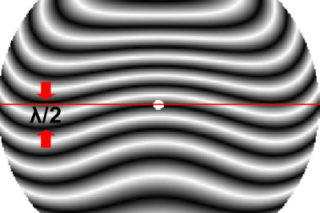
As we have seen in this article, a convex secondary mirror can not be tested directly in general (*) . One of the methods is used to refer to a concave mirror which has the same shape of the surface that we want to get on the convex mirror. By overlaying the two mirrors, the analysis of the interference fringes by means of


Building a Ritchey-Chretien: preconditions
And, it's possible to do it (*) by manually working the optics and you don't need special equipment or more sophisticated than what we normally use for the construction of a parabolic mirror but, let us now, to embark on such an adventure necessarily have to have more than one working behind, to understand how to generate two hyperbolic surfaces, and
Read More