
- This topic has 25 replies, 3 voices, and was last updated 5 years, 3 months ago by
Giulio TiberinI .
-
AuthorPosts
-
21 January 2019 at 21:26 #11298
Bravo Fabio!
I'd say you have a nice one “mano” light and effective, because you did a good job of not easy, cautious positive progression, greatly improving the P / V ratio. So with yourself 32 nanometer error, also the bord rabattus I don't think will be of great disturbance to the star test.22 January 2019 at 8:02 #11299Thanks Giulio, ma direi che sono stato fortunato e anche grazie ai vostri consigli
 e, comunque, sostegno…
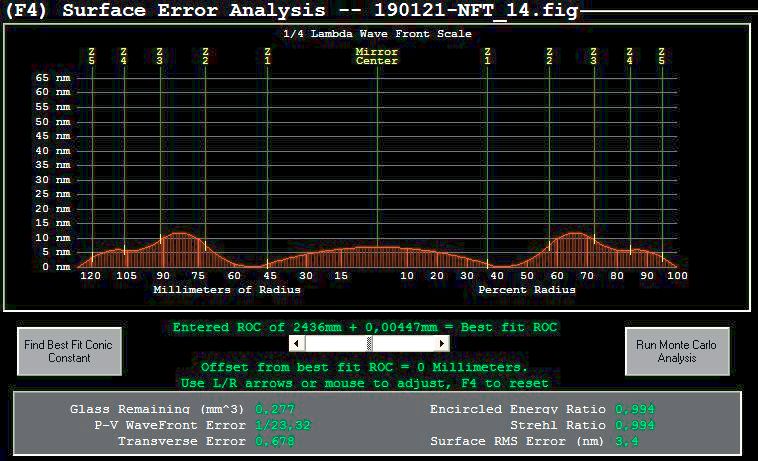
Ho fatto l’ultima misura dopo il ritocco concentrato tra zona 4 e 5. I know, è ridicolo:
Molto più realistico questo, nel quale ho simulato 3 mm circa di bordo ribassato:
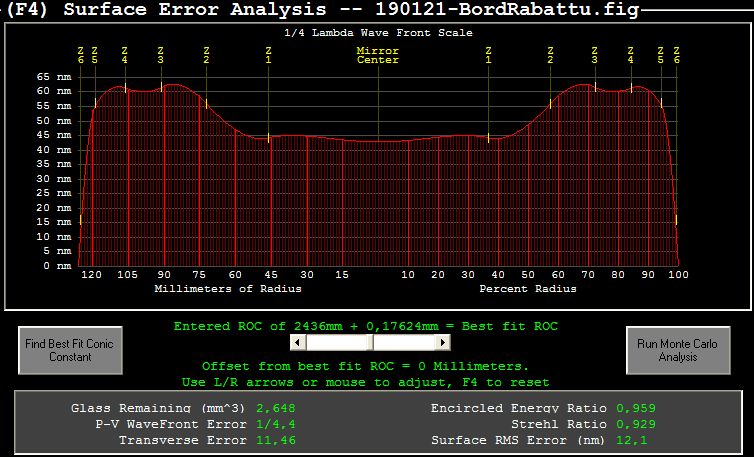
Se così fosse rimarrebbe comunque un vetro di discreta fattura che dovrebbe soddisfare il mio …”cliente”.
Vedremo il comportamento sul campo!
22 January 2019 at 9:20 #11300Sincere congratulations, un lavoro eccellente! se Riesci a fare un rochi dell’intera superficie possiamo valuare anche la qualita’ riduardo rugosita’ e stato generale della superficie, potendo escludere cosi’ anche eventuali problemi non visibili al foucault come errori locali ed anche capire l’entita’ del possibile bordo ribattuto.
22 January 2019 at 9:26 #11301A tip that comes to mind, in order to better evaluate the edge problem, is to blacken the caulk even with an indelible marker, that slightly attenuates its annoying and disturbing reflection, or to cover it with the external windows of the Couder mask well in contact with the mirror.
Another suggestion is to see with your software the Millier-La croix diagram which in practice is how the segments representing your areas are positioned, towards the “"trumpet bell"” of machining tolerances (which are loose in the center but very narrow at the edge).
Finally if you want read here an always interesting situation:
https://dobsoniani.forumfree.it/?t=6898588022 January 2019 at 10:19 #11303Purtroppo non mi sono mai attrezzato per fare il Ronchi… bisogna che mi decida!
Col diagramma M-L, simulando, come ho detto una puntata al bordo ribassato, ho ancora tutto dentro la tromba con ovviamente una forte puntata al di fuori della zona “6” cha andrebbe oltre il 200%.
Stimando l’entità della superficie della corona esterna direi che, comparata alla totalità dello specchio (meno l’ombra del secondario), saremmo intorno a circa il 5% della luce totale.
Direi che (sempre da provare sul campo) al massimo: per ossevazioni planetarie si può provare a diaframmare leggermente il primario. Per il Deep certamente tutto diametro.
23 January 2019 at 8:02 #11304Giulio, ho provato a fare un’altra puntata di Foucault alla zona 5 mascherando la parte più esterna (circa 3mm) del bordo ribassato. Volevo stimare meglio, in this way, l’effettiva curvatura di zona 5 ed assicurarmi , the name, che almeno fino a quel diametro fosse ok. Le misure precedenti, come dicevo, of the area 5 erano state difficili perchè, oltre alla diffrazione, il bordo ribassato rendeva una buona parte della zona di intensità totalmente diversa dal resto: difficile stimare la luminosità del centro. Sembra invece che la misura della zona5 “mascherata” sia ben congruente con il resto della superficie. Rimarrebbe perciò solo l’anello di 3mm circa, residuo della forma precedente, già ribassato. Penso che lo “sopporteremo” so, col suo 5% light….
 23 January 2019 at 18:20 #11305
I agree. Is’ too risky to touch that area.
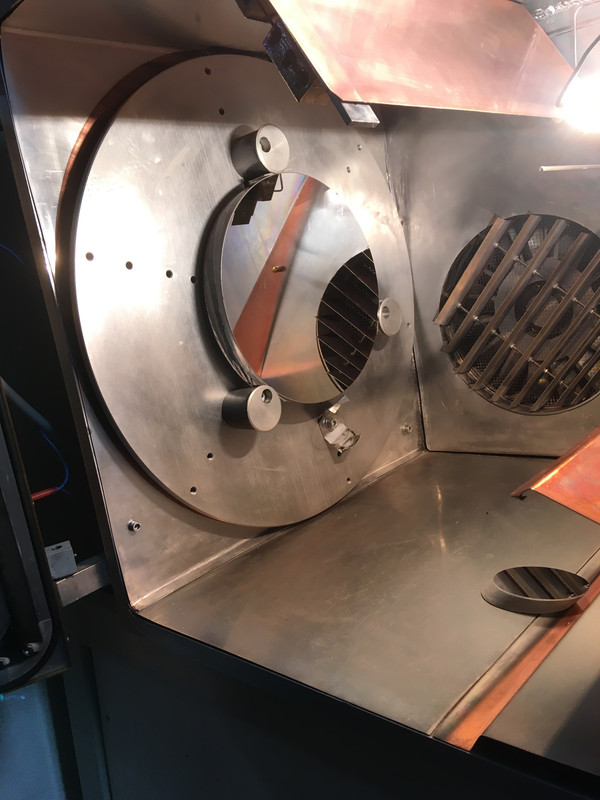
27 January 2019 at 14:05 #11306And here is the moment of aluminizing:
Vi farò sapere la reale resa quando sarà montato e, Finally, usato sul cielo
Fabio
28 January 2019 at 0:27 #11307The rotating plateau on which the mirror is installed is interesting!
I don't mean much about empty autoclaves for the storage of alumination.
You can describe how the photographed one works?29 January 2019 at 9:53 #11308Purtroppo non ne so molto neanch’io delle camere da alluminatura. Ho solo avuto qualche esperienza con vuoti da trattamento plasma, molto più …blandi.
In questa camera, in particolare, c’è una bella pompa turbomolecolare (the “ventola” sulla destra dell’immagine) from 2000 litri/ora su cuscinetti magnetici (così non c’è olio che possa evaporare -sebbene esistano olii “da vuoto” meno ce ne sono in giro meglio è). Con questa pompa si riesce a fare il vuoto in circa 2 hour (e qui il vuoto è 1E-7 bar!).3 February 2019 at 20:33 #11310I know a little vacuum technology because I took charge of the construction of large electrical transformers in medium voltage, and transformers for high frequency induction of steel tubes welding generators. All vacuum impregnated in epoxy resins of the first and the second silicone to eliminate and blowholes in the insulating castings.
But the required vacuum was not as driven, and it was already obtainable with common to oil ring vacuum pumps.
I also know the molecular pumps that operate at “Rain”, molecular exploiting the removal by shock of the few molecules remained by the vacuum in oil, necessary to achieve very vacuums. -
AuthorPosts


- You must be logged in to reply to this topic.