


CREATION OF A PARABOLIC MIRROR 410 mm f/4.5 – PARABOLIZATION
After bringing the mirror to the sphere, the moment of parabolization has arrived, which in many respects is perhaps the most delicate phase of the entire process.

After bringing the mirror to the sphere, the moment of parabolization has arrived, which in many respects is perhaps the most delicate phase of the entire process.

The mirror processing was carried out with a mirror-o-matic type machine, characterized by a rotating table and an oscillating arm on which the tool is fixed.

In these chapters I will describe the phases that led me to the creation of a parabolic mirror 410 mm f/4.5, focusing first on the phases that led me to create a good spherical surface

As a continuation of the previous article (Cooling telescope mirror) I report the results of some fluid dynamics simulations conducted on a control volume equal to that contained within the primary box.

The next step in the design phase and determination of the appropriate position of the various baffles along the optical path, It consists in the realization of real shielding elements. As it said until now, It is particularly easy to apply to your telescope, if the study for the positioning of the baffles has been made in a phase of

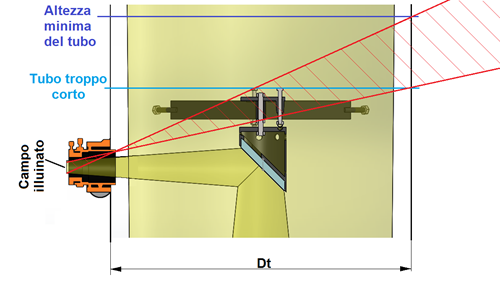
POSITIONING OF SETTI Septa in the main pipe: Once the length of the tube, you can begin to determine where they must be placed the internal baffles, to be able to block the off-axis light entering the telescope, and reflected or scattered from the inner surfaces, before this I can get on the primary mirror or focal plane.

One of the aspects that can be taken to enhance the performance of a telescope, It is linked to the undesired phenomenon of scattered light, due to reflection of the radiation that comes from external sources by the surfaces that precede the telescope detector (or eyepiece), which are characterized by a certain surface roughness (from


The material issue to be taken to build one for telescope mirror is quite fascinating. If you start from a hypothetical initial question (of which we do not know a priori the solution) which is: If you have to build a mirror for a telescope, what material is more convenient to do so? The most obvious answer and obvious that

To obtain good interference fringes, for the control of optical surfaces, through the so-called "test plate", It is necessary to have a 'apparatus allowing to uniformly illuminate, with a monochromatic light, the two glasses under test and redirect the resulting image at the device or towards the observer. The device itself is




Collimare a laser collimatore
One of the activities that every amateur should run it on your telescope, to take advantage of a powerful tool, It is the collimation of the optical. To do this, there are several techniques, that exploit various devices, like a needle pierced the door or a collimator Cheshire or Autocollimator or through the Star Test, or by using a laser collimator.
Read More